
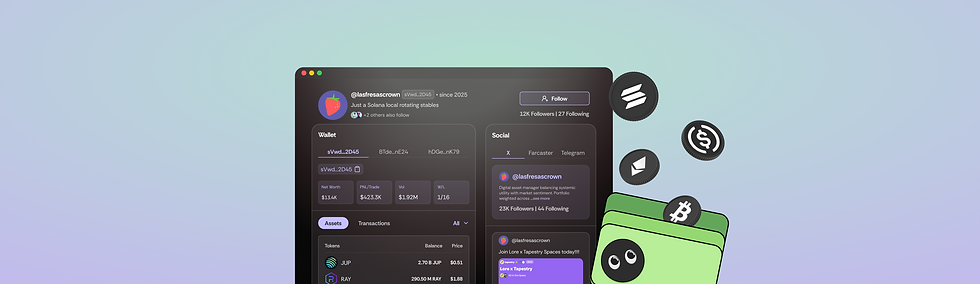
Solana Social Explorer (SSE)
Designing the Social Layer for On-Chain Identity
On a public blockchain, every trade and token you’ve ever held is visible to anyone. Yet, the tools for navigating that world treat it like a spreadsheet, not a place full of people. Solana Social Explorer (SSE) was built to change that, merging wallet activity with social identity to give traders the context behind every transaction.
Without it, SSE is just another Solscan clone: interchangeable, with no reason to come back. With it, SSE becomes a place, not just a tool.
I led the experience design for SSE’s social wallet profile, turning an anonymous string of characters into someone worth knowing.
Role
Lead Product Designer
Collaborators
Nehemiah Blackburn (PM)
Elira Duro (Head Designer)
Breaking Down the Trader’s Tools
A crypto wallet isn't just a transaction log: it's an identity that spans wallet activity, social graph, and presence across different platforms like Farcaster, .sol domains, Twitter/X, Telegram. SSE is built on Tapestry, a social graph protocol on Solana that makes this possible: aggregating identity signals across platforms so a single wallet profile can show who someone is without users having to manually connect each one.
This creates a bit of a hard information architecture problem: when someone lands on a profile, what comes first? Their holdings? Their follows? Their trade history? Their off-chain identity signals?
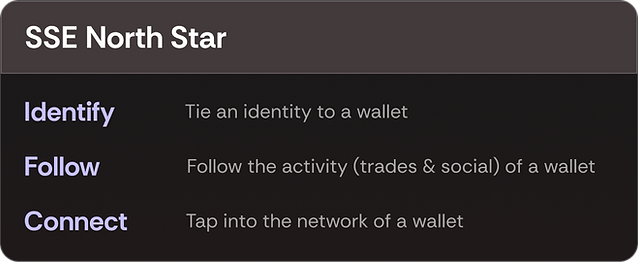
The SSE North Star aims to these three main actions for a user:
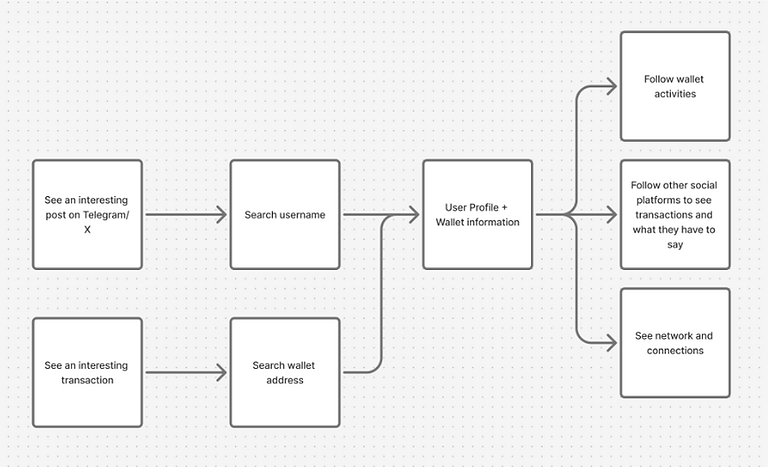
To understand how users were actually arriving at this problem, I mapped out the two most common entry points: seeing an interesting post on socials, and spotting an interesting transaction on-chain. Both led to the same destination: a wallet profile, but with different expectations about what they’d find there.
Iterations
I explored two directions, each representing a different answer to the core hierarchy question: what does a trader need to see first?

Iteration 1: Prioritizing Activity on SSE
This direction aimed to highlight SSE-specific activities: swaps/transactions, comments, follows. The business logic made sense: more time spent on platform = more trades made. But, it worked against the north star: users weren’t coming to SSE to be kept there, they were coming to understand who they were dealing with and make fast, informed decisions. This concept was optimizing for retention without solving the identity problem first.

Iteration 2: Prioritizing Transactions
This direction led with wallet transactions and portfolio data, closer to how Ethereum social apps handle it, and familiar to most traders. But identity became an afterthought. Users had to piece together who someone was by analyzing their transaction history, rather than getting a clear signal upfront. Finding a wallet should give an immediate read on who a person is, not requiring investigative work.
Solution
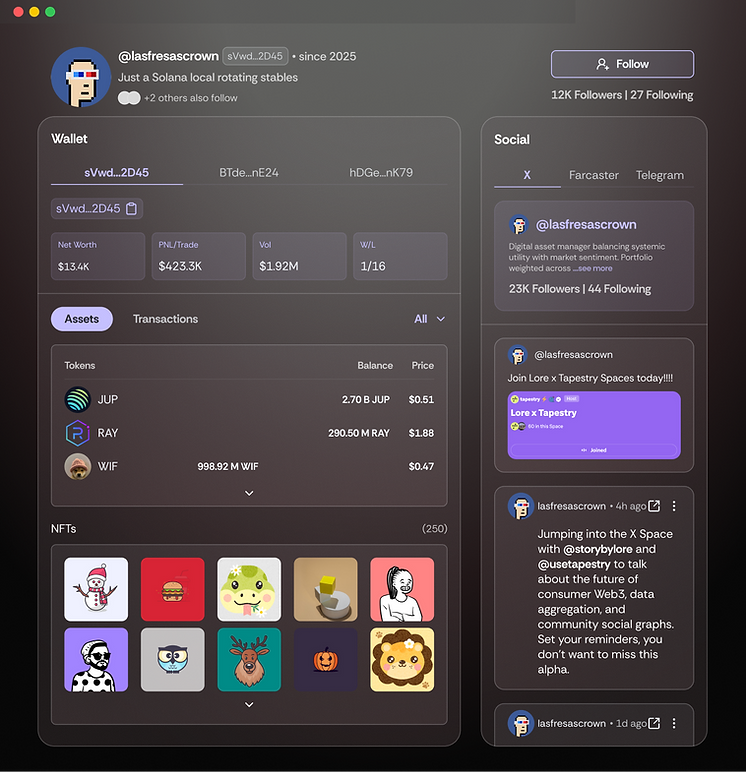
The final design makes everything visible in one scan without leaving the page: a two-column system with wallet data on the left, and social context on the right, and an unintrusive header that ties multiple wallets and identities under one SSE presence.
The left column gives traders what they expect: quick access to transactions, token holdings, and portfolio highlights. The right column gives them what SSE uniquely offers: a snapshot of who this person is across platforms without having to cross-reference external sites.
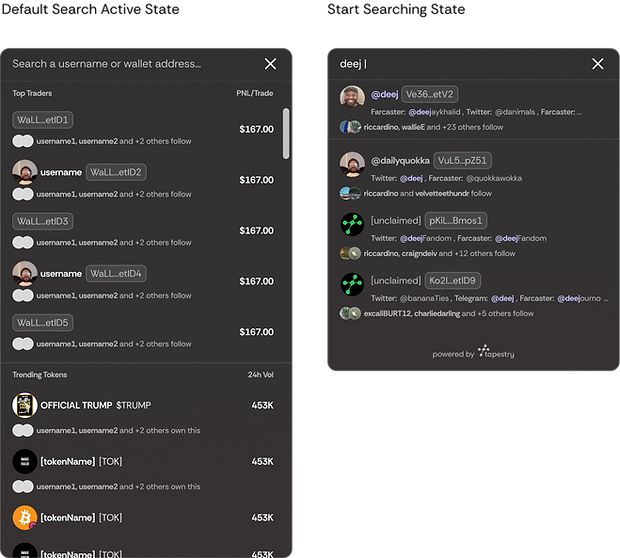
The solution also extended to the platform’s search, prioritizing results in three tiers: 1 claimed SSE usernames, 2 SSE accounts linked to Twitter, and 3 unclaimed wallet addresses with associated socials. When you look up any wallet, you get not just the transaction history, but the person’s full cross-platform presence via Tapestry’s Identities API.
.png)
What This Taught Me About Character Design

The wallet profile shipped and what followed confirmed the concept of social profiles was right, even where the execution fell short.
Overall from the product side, SSE gained real traction when it was combined with the right mechanics: Feeds, Copy Trade, and Suggested Follows working together turned social features from a nice-to-have into core retention drivers.The SSE x Pudgy Penguins collab extended that social context into NFT communities, and integrations with Solana ID and Twitter handles made identity portable across apps, pulling from 15+ platforms via Tapestry Identities API.
The clearest external validation came from Lore: after integrating Tapestry identity infrastructure, 90% of new signups had profiles auto-filled instantly from existing Tapestry data, generating 14,000+ profile views.
However, traction was ultimately underwhelming: a good feature in the wrong container. The execution and community infrastructure wasn’t there to support it. There was inconsistent communication, no dedicated SSE social presence, and no active Discord.
What I took from it: shipping into a crypto-native space isn’t just a product problem: it’s a community problem. Understanding how a community discovers, adopts, and creates space for a feature matters as much as the feature itself. Good design can’t compensate for the absence of community trust and transparency around it.
